
All art is about communication.
The act of composing is born from a desire to reach out to others, to find like-minded people with whom to share your experience. These need not be artists themselves. If we're lucky, we find non-professionals who are attracted to our music whom we find we reach at various levels. If we're lucky. And if we're even luckier, we might hear about it.
Music is no exception. Often, the question of how music is able to communicate anything is boiled down to the old contest between music meant to be enjoyed for its own sake ("absolute music") and music that tells a story ("program music").
I recently, read a post on Reddit asking why so much contemporary music is “programmatic.” The poster pointing out how much new music has seemingly endless program notes about what the piece is about, etc. Program notes used to include a lot of often technical language explaining how a piece is put together. This goes back to the days not that long ago when most of our audiences were fellow professionals. But towards the turn of the century composers started reconnecting with a more general audience, and program notes got began to focus more on the piece's story.
Story, however, is not necessarily the same as narrative.
Music cannot really tell a story. Not without words. Music, after all, is not a language (in the words of the Dread Pirate Roberts, “anyone who tells you otherwise is lying or trying to sell you something”). It often behaves like one, but it lacks a common syntax and grammar that can be understood among individuals, let alone cultures. What composers have done since at least the Renaissance is to create a series of similes: symbols that suggest a certain gesture, mood, or character. Like when Back sets the text, “my God, how long! How long!” in a cantata:
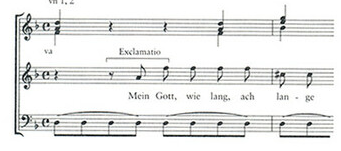
The “exclamatio” here is what theorists in Bach's day would have called that leap. It's literally an exclamation.
Or this delicious passage from Monteverdi's “The Nymph's Lament” from his 8th book of Madrigals:
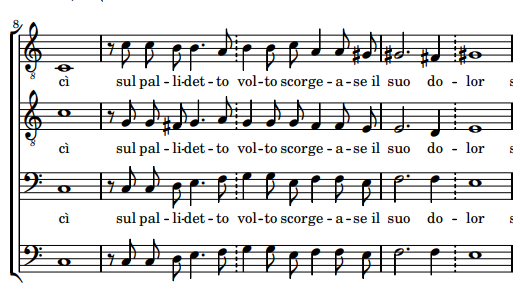
The last word is “pain,” and Monteverdi sets it with a clashing dissonance that literally hurts.
And, in the same piece, he invents this gem:

This little figure became so tied up with the idea of sadness, of lamenting, that it became literally known as the lament bass. It goes from this piece all the way up to “Hit the Road, Jack” and “Babe, I'm Gonna Leave You.” Alex Ross did a write-up about this that's very cool, if you want to dig deeper.
But what about atonal music?
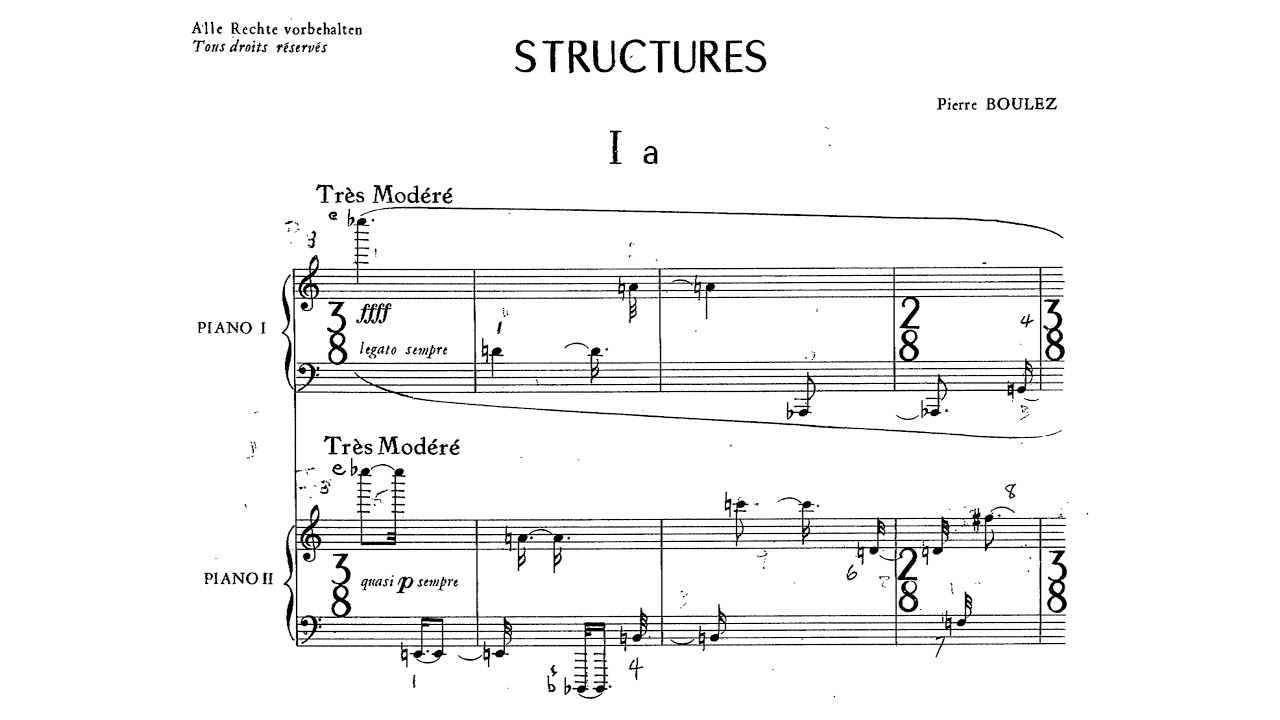
Writing music like this is itself an act of communication. It may not set out a narrative, but it tells a story. Pierre Boulez, who wrote this piece, embraced this style out of a need to get rid of “expressivity," which was part of an aesthetic that he and other artists his age thought led to the world wars that ravaged the first half of the 20th century. Pierre Boulez grew up during WWII. He grew up under occupation, around bombed out, ruined cities and the constant threat of destruction while studying in Paris. That kind of thing gets to a guy! And this is not just a communicative act but also a political one. All art, it turns out, is also political (more on that some other time).
My point is: motivation isn't as important as results. And the result is a story. We all have a story, and music is no different. How we tell it really doesn't matter so much as long as we tell it…and tell it well.